
Your Body Isn’t Broken. It’s Protecting You.
Part 2: Understanding Your Nervous System: The Sympathetic Nervous System
As we continue our journey into understanding the nervous system, this is the second installment in my Nervous System Blog Series. Today, we’re taking a closer look at the Sympathetic Nervous System.
If you missed the first blog, Understanding Your Nervous System: A Gentle Overview, you can read it here.
Your sympathetic nervous system is one branch of your autonomic nervous system. I often tell my clients to think of the autonomic nervous system as their automatic nervous system because it quietly manages countless functions every moment of every day without us having to think about them.
Your heart beats.
You breathe.
Your blood pressure adjusts.
Your digestion works.
You sweat when you’re hot.
Your body is constantly working behind the scenes to keep you alive.
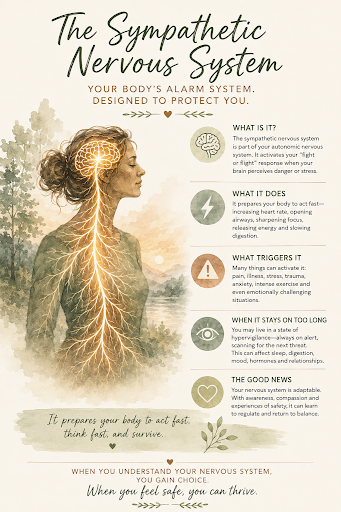
The sympathetic nervous system is often referred to as our fight or flight response. Its job is simple:
To help us survive.
When your brain perceives danger, whether that danger is real or simply perceived, your sympathetic nervous system mobilizes your body for action.
Within seconds, remarkable things begin to happen.
- Your pupils enlarge so you can see more clearly.
- Your heart beats faster to deliver oxygen-rich blood to your muscles.
- Your airways open so you can take in more oxygen.
- Your liver releases stored glucose to provide quick energy.
- Digestion slows because survival takes priority over processing lunch.
- Your muscles become primed to move quickly.
Even your immune system and your body’s repair systems begin preparing in case you’re injured.
Your body is brilliantly designed.
The Chemical Messengers
The sympathetic nervous system communicates through powerful chemical messengers called neurotransmitters, including:
- Norepinephrine
- Epinephrine (adrenaline)
- Acetylcholine
These chemicals coordinate the rapid changes that prepare your body to respond.
Where Does This System Live?
Most sympathetic nerve signals begin in your spinal cord.
From there, they travel through clusters of nerve cells called ganglia, which act like relay stations, sending messages throughout your body to your heart, lungs, blood vessels, sweat glands, digestive organs and many other systems.
The primary building block of this incredible communication network is the neuron, a specialized cell designed to send and receive electrical signals.
The more I learn about the human body, the more I stand in awe of its wisdom.
What Activates the Sympathetic Nervous System?
Many things can activate this system, including:
- Physical pain
- Illness or disease
- Injury
- Emotional trauma
- Chronic stress
- Anxiety
- Genetic conditions
- Intense exercise
The sympathetic nervous system isn’t only responding to physical danger.
It also responds to emotional danger.
Here’s something I believe everyone should understand…
Your nervous system doesn’t always distinguish between a charging coyote and a stressful email, a difficult conversation, financial worries, the fear of being rejected, or a painful childhood memory.
To your nervous system…
Threat is threat.
When Survival Mode Becomes Home
The sympathetic nervous system is designed to activate for short periods of time.
The challenge is that many of us no longer experience stress as an occasional event.
We experience it as a lifestyle.
For those who have lived through trauma, chronic stress, unpredictable relationships or environments where they never truly felt safe, the nervous system can become hypervigilant.
Hypervigilance is much more than simply being alert.
It’s living as though danger could appear at any moment.
You may find yourself constantly scanning a room, anticipating the worst, startling easily, struggling to relax, overthinking conversations, or feeling responsible for everyone else’s emotional state.
Over time, your nervous system can begin to mistake familiarity for safety.
Even when life becomes calmer, your body may continue searching for the next coyote.
When the sympathetic nervous system stays activated for weeks, months or even years, it can begin affecting our sleep, digestion, hormones, immune function, mood and relationships.
This isn’t because your body is broken.
It’s because your body has been working tirelessly to protect you.
The good news?
Our nervous systems are wonderfully adaptable.
With awareness, compassion and repeated experiences of safety, they can learn to regulate again.
Safety is the foundation of my work with clients.
A Story From My Own Life
A few weeks ago, I experienced the sympathetic nervous system in real time.
It was a beautiful day, and I was walking with my grandson Trevor in his stroller at the Sheep Pasture in Easton. I felt completely relaxed. We were enjoying the fresh air, the sunshine and simply being together.
Then I happened to glance toward the bushes.
Out stepped a very large animal.
You have never seen a 66-year-old woman move so fast!
My entire body shifted in an instant.
My heart pounded.
My breathing changed.
Every ounce of my attention focused on protecting my grandson.
There was no debating.
No analyzing.
No wondering what to do.
My body had already decided.
Fight or flight?
Definitely flight!
I turned that stroller around faster than you can imagine and sprinted like a wild woman to get us to safety.
The “threat” turned out to be a very large coyote.
Thankfully, we were completely safe.
But what fascinated me wasn’t just how quickly my body reacted.
It was how long it took my nervous system to realize the danger had passed.
Even after we were safe, I could still feel my heart racing and the adrenaline coursing through my body.
That experience gave me an even deeper appreciation for what so many of us experience every day.
Sometimes the danger is real.
Sometimes it isn’t.
The coyote disappeared into the woods.
But for many people, the body never gets that message.
It continues living as though the coyote is just around the next corner.
That is what chronic hypervigilance can feel like.
Either way, our nervous system responds with one goal:
To keep us alive.
For that, I have tremendous gratitude. Thank you, nervous system.
Learning how to gently help our nervous system return to safety isn’t about becoming tougher or more resilient.
It’s about honoring the incredible intelligence that has been protecting us all along.
Because healing doesn’t begin when we fight our nervous system.
Healing begins when we help it remember that, in this moment, it is safe.

