
The Parasympathetic Nervous System: The Power of the Exhale
Continuing my Nervous System Blog Series…
Over the past two months, we’ve explored the Central Nervous System, our body’s command center, and the Sympathetic Nervous System, the amazing system designed to help us respond to life’s challenges.
This month, we’re turning our attention to another remarkable part of the story: the Parasympathetic Nervous System (PNS), often called our rest and digest system. Before I dive in, I’d like to begin with something a little more personal. The place that activates my parasympathetic nervous system in a split second is the beach.
The moment my feet sink into the warm sand, I hear the rhythmic sound of the waves, watch the sun dancing across the water, and allow myself to take in the beauty of nature. It’s as though my whole body takes one long, deep, letting go, kind of exhale.
Everything softens.
My shoulders drop.
My breathing deepens.
I don’t have to tell myself to relax.
My body simply remembers.
For you, it may not be the beach. It might be sitting beside a crackling fire, walking through the woods, rocking your grandchild, listening to your favorite music, cuddling your dog, wrapping your hands around a warm cup of tea, or sharing one of those deep, uncontrollable belly laughs with a friend where tears are streaming down your Face. (Another one of my personal favorites!)
Notice what happens afterward. That big sigh. Your shoulders soften. Your body feels lighter. Your breathing naturally slows.
That feeling… that settling… that beautiful exhale… That’s your parasympathetic nervous system coming online.
Our exhale has a special relationship with the parasympathetic nervous system. A slower, longer exhale sends a message throughout the body: You’re safe. You can le go. It is one of the simplest ways to begin shifting your physiology toward restoration. And that’s the beautiful thing about our nervous system. It isn’t working against us. It’sconstantly working for us, seeking balance, restoration, and healing.
What Exactly Is the Parasympathetic Nervous System?
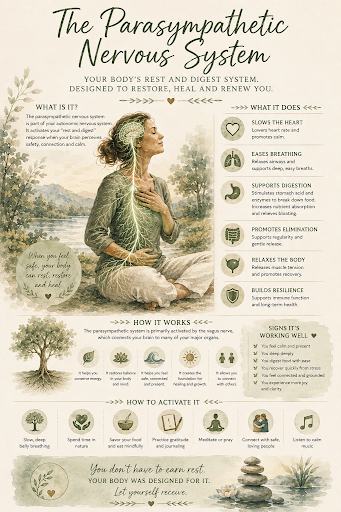
The parasympathetic nervous system is one half of your autonomic nervous system, regulating functions such as your heartbeat, breathing, digestion, blood pressure, and many other processes that happen automatically every moment of the day. While the sympathetic nervous system prepares your body for action, the parasympathetic nervous system helps you recover afterward. Think of the sympathetic nervous system as the accelerator in your car. The parasympathetic nervous system is the brake. You need both. Health is found in the flexibility to move between them as life requires.
When your parasympathetic nervous system is active, your heart rate slows, breathing deepens, digestion improves, blood pressure decreases, your immune system becomes more active, tissues repair more efficiently, and your mind often becomes clearer, more creative, and more connected.
One of the major players in this process is the vagus nerve, the longest cranial nerve in the body. It serves as a communication highway between your brain and many of your internal organs, including your heart, lungs, and digestive tract. When your body believes it is safe, it begins doing what it was beautifully designed to do: restore. Repair. Digest. Heal.
That’s not just relaxation. That’s biology.
When Rest Doesn’t Come Easily
If you’ve ever found yourself thinking, ‘I know I should relax, but I just can’t…’, please know there is nothing wrong with you.
Many of us have spent years living with chronic stress, caregiving, grief, trauma, perfectionism, or simply trying to keep all the balls in the air. Over time, our nervous systems become so accustomed to living with one foot on the accelerator that slowing down can actually feel unfamiliar and sometimes even uncomfortable.
Your nervous system isn’t resisting peace. It’s responding to what has become familiar. The beautiful thing about our nervous system is that it can learn. Just as our bodies learned survival, they can also learn safety. One breath. One walk in nature. One nourishing meal. One genuine belly laugh. One moment of feeling deeply seen by another person.
We Weren’t Meant to Regulate Alone
From the moment we’re born, our nervous systems develop in relationship with other people. A calm voice, gentle eye contact, a caring touch, and someone who listens without trying to fix us all communicate safety.
This is called co-regulation. Even as adults, our nervous systems continue responding to one another.
Have you ever noticed that after sitting with someone who feels deeply grounded, you begin to breathe a little easier yourself? That’s not your imagination. That’s biology.
Coming Home Practice
Find a comfortable place to sit with your feet resting on the floor. Take a gentle breath in through your nose and allow your exhale to become just a little longer than your inhale.
As you continue breathing, quietly ask yourself: Where do I feel myself softening?
Just notice. Not fix.
If your body doesn’t settle right away, that’s okay. Awareness always comes before change. Offer yourself the same kindness you would offer someone you love. Until next month, may you find moments each day to pause, breathe deeply, and remember that your body isn’t working against you. It’s always trying to bring you home. Next month we’ll explore the amazing vagus nerve and its role in regulation.

