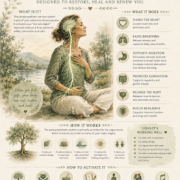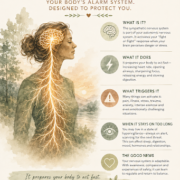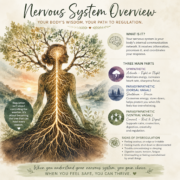
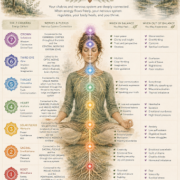
Infographic titled “Nervous System Overview: Your Body’s Wisdom, Your Path to Regulation.” The graphic explains the three main parts of the nervous system: the sympathetic nervous system (fight or flight), the parasympathetic dorsal vagal state (shutdown or freeze), and the parasympathetic ventral vagal state (connect, rest, and digest). It also lists common signs of nervous system dysregulation, including anxiety, disconnection, digestive issues, tension, fatigue, and feeling overwhelmed. The illustration features a seated figure with a glowing nervous system integrated into tree roots and branches. The closing message reads: “When you understand your nervous system, you gain choice. When you feel safe, you can thrive.”

Understanding Your Nervous System: A Gentle Overview

For quite some time now, I’ve written and spoken a great deal about nervous system regulation. It recently dawned on me that I may have skipped an important step…

I’ve been talking about regulating the nervous system without first taking time to explain what the nervous system actually is and how it works.

So, with that in mind, I’ll be beginning a series of blogs exploring the different branches and functions of the nervous system and how they influence our thoughts, emotions, relationships, energy, and overall experience of being human.

In this first piece, we’ll begin with a gentle, big-picture overview.

Because before we talk about regulation, we need to understand what exactly is doing the regulating.

Your nervous system is your body’s communication network. It is constantly gathering information from both your outer world and your inner world, interpreting whether you are safe or threatened, and organizing responses accordingly.

Long before the thinking mind catches up, your nervous system has already begun making thousands of tiny adjustments: changing your heart rate, influencing digestion, shaping muscle tension, shifting attention, affecting emotion, and determining whether you move toward connection, protection, action, rest, or withdrawal.

Its primary job is not happiness. Its primary job is survival.

And yet, when functioning well, it gives us access to something much richer than survival alone: presence, flexibility, vitality, connection, and the ability to meet life with greater resilience.

A Bird’s-Eye View: Meet Your Nervous System

At the broadest level, the nervous system can be thought of as having two major parts..

1. The Central Nervous System (CNS)

This is made up of the brain and spinal cord.

Think of it as the body’s central processing center. The CNS receives information, interprets it, stores experiences, creates meaning, and helps coordinate responses.

It allows us to think, remember, imagine, make decisions, and initiate movement.

But interestingly, the brain is not operating alone. It is in constant conversation with the rest of the body.

Which brings us to the second major division…

2. The Peripheral Nervous System (PNS)

This includes the vast network of nerves extending throughout the body.

If the CNS is headquarters, the PNS is the communication highway.

Its job is to carry information back and forth between the brain, spinal cord, organs, muscles, and tissues.

One branch of the peripheral nervous system helps us move voluntarily, like lifting an arm or taking a walk.

Another branch operates largely outside conscious awareness.

This is called the autonomic nervous system, and this is where much of our future conversation will live.

The autonomic nervous system helps regulate functions like:
• Heart rate
• Breathing
• Digestion
• Blood pressure
• Energy use
• Stress responses
• Rest and recovery

Within the autonomic nervous system are different pathways that help us respond to life.

You may already be familiar with terms like sympathetic (often associated with mobilization, action, and protection) and parasympathetic (associated with restoration, connection, and conservation of energy).

These systems are not enemies competing against one another.

They are designed to work together in an ongoing dance of adaptation.

A healthy nervous system is not one that remains calm all the time.

It is one that can respond appropriately, recover, and return to balance.

As we move through this series, we’ll explore each branch in more depth and talk about how stress, trauma, relationships, lifestyle, and everyday experiences shape our nervous system over time.

For now, I’ll leave you with a question:

What signals is your nervous system receiving most often these days… urgency, pressure, and protection… or safety, connection, and enoughness?

Your body may already know the answer.

Young child with a yellow bow in her hair, smiling with colorful paint on her face, arms, and shirt, looking off to the side outdoors.

When the Body Speaks: Healing Physical Symptoms Through Inner Child Work

There are moments when the body whispers…
and moments when it demands to be heard.

A tight chest that won’t let go.
Anxiety that arrives in the quiet of the night.
Sleep that feels just out of reach.
A nervous system that never quite settles.

So often, we try to fix the symptom.

But what if the symptom is not the problem?
What if it’s the message?

As children, we don’t have the capacity to fully understand or process everything we experience.

We rely on our environment to feel safe, soothed, and seen.
When those needs are not consistently met, the body adapts.

It learns. It organizes around survival. And what isn’t processed doesn’t disappear—it gets stored.

Not as a story in the mind…
but as sensation, tension, and patterns in the body.

This is what we often refer to as the inner child—not a concept, but a living imprint within us.

Many of the symptoms people struggle with today—
anxiety, chronic stress, sleep disturbances, even certain physical conditions—
are not random.

They are intelligent responses from a nervous system that learned early on how to stay safe.

You might notice:

  • Feeling anxious when someone pulls away or doesn’t respond
  • Difficulty relaxing, even when nothing is “wrong”
  • A constant sense of bracing or vigilance in the body
  • Trouble falling or staying asleep

These are not signs that something is broken.

They are signs that something inside you is still trying to protect you.

We cannot think our way out of patterns that live in the body.

Healing begins when we create a sense of safety within.

Not forcing the body to change…
but inviting it to soften.

This is where inner child work becomes powerful.

We begin to:

  • Listen to what the body is communicating
  • Recognize the younger parts of us that are still carrying unmet needs
  • Gently bring awareness, compassion, and presence to those places

Over time, the nervous system begins to reorganize.

Not because we made it…
but because it finally feels safe enough to.

What if, instead of asking:

“What’s wrong with me?”

You asked:

“What is my body trying to tell me?”

That shift alone can open a completely different relationship with yourself.

One rooted not in frustration or fear…
but in curiosity, compassion, and connection.

If this resonates, I invite you to listen to my recent podcast conversation with Dee Davidson, where we explore this work more deeply—how early experiences shape the nervous system, and how healing unfolds through the body.

🎙️Podcast episode

You don’t have to figure it all out. Actually, it isn’t meant to be figured out. Feelings live in our body, not our mind. And your body already knows the way!

Here’s to holding your inner child!

Golden sunset over the ocean at Palm Beach, Aruba, with boats on the horizon and gentle waves near shore.

Travel as a Path to Expansion

As I watch this beautiful sunset on Palm Beach in Aruba, with the soft breeze around me, it’s like an invitation to soften deeply into myself. My breath expands as my body softens. Something shifts in me when I travel. It’s not just the change of location, it’s my awareness. My pace. My way of being with myself.

Travel, I have come to realize, is not about going somewhere else, it helps me return to myself. 

In unfamiliar places, without the usual daily routines, we meet different layers of who we are. The reflective self who watches the sunset on the ocean where time dissolves. The openhearted self who connects easily with strangers. The intuitive self who has the space to listen more deeply to inner nudges. These parts aren’t created by travel, they are revealed by it! Last night I danced with locals to Latin music – didn’t understand a word of the songs, but let the beat of the music move my body. We could not communicate verbally, but our moving bodies spoke to each other. Connection was felt through a smile, a gaze, moving hips.

Here in Aruba, I feel expansive. Free. Relaxed in a way that touches my Spirit. There’s a deeper sense of alignment that emerges when I step outside of my daily life. I notice more. I feel more. I am more. Travel gently dissolves the noise so I can hear myself once again.

For soul seekers, travel becomes sacred terrain. Each destination is not just a place on the map. It becomes a teacher, a doorway. The outer landscape reflects the inner one, and suddenly oceans, skies, and silence begin speaking a language you didn’t realize you remembered.

That’s why I feel drawn to my next journey: The Azores.  There’s something about those volcanic islands sitting on the Atlantic Ocean that feels like a calling. Wild, elemental, untouched…….just like US! I sense it will be the kind of destination that invites contemplation as naturally as breathing. Not a trip filled with distractions, but one filled with presence. 

Travel for me is not about checking places off on my bucket list, but rather it is about what will the vibration of this place awaken in me?

Every time we answer the call to explore the world, we’re really answering the call to expand into ourselves. 

If your Spirit has been craving space, stillness, connection, or something you can’t quite put your finger on, maybe that feeling is a compass. Maybe it’s pointing you toward your own expansion. 

If you feel called to travel not only across the world, but deeper into yourself, I invite you to follow along with me to the Azores. I’m hosting a women’s retreat from October 5-12.

Explore the Azores Retreat


There is something powerful that happens when women gather in circles that mirror their own depth. It is the perfect setting to soften, to reflect, to shed old layers, and to step into a more expansive version of ourselves. This retreat is not about escaping life. It is about meeting it more fully. Together! 

It is about creating sacred space for women to reconnect to their intuition, their clarity, their truth. To remember who they are beneath the daily routines and noise. Travel becomes the container, but the real journey is inward. 

And yet, expansion is not reserved for plane tickets and passports. You might not be able to travel across the world right now. But we can all travel!  We can bring our curiosity to the edges of our everyday lives. A new coffee shop in your neighborhood. A part of town you have never wandered through. A solo day trip. A different route home. You get my drift.

Whether you join me in the Azores or begin by exploring what is beyond your front door, the invitation is the same: stay curious. Stay open. Let the world, near or far, reveal new dimensions of your precious SELF! 

From my heart to yours,

Tina


Woman sitting with eyes closed, holding her temples, with illustrated lightning and heartbeat lines around her head representing stress or nervous system overload.

SAFETY FIRST: THE QUIET POWER OF NERVOUS SYSTEM REGULATION

Before we understand what’s happening in the world, our bodies already know.

They tighten, brace, speed up, shut down. Long before the mind catches up, the nervous system has taken note.

I work with people all day, every day. People from all walks of life, from different states and countries. And I keep hearing the same question: What’s going on? Things feel crazy everywhere. We are living in a time of immense global change.

If you’ve ever tried to change a belief system or shift a habit, you know that chaos often shows up first. Now multiply that chaos by billions of people (over 8 billion, to be exact), all navigating uncertainty at once. You get the picture.

The collective energy affects all of us. There’s a particular quality to it right now. Things feel fast, loud, and unsettled. Many of us are carrying more than we realize, absorbing the state of the country, the world, and the people around us into our nervous systems and bodies, often unconsciously.

If you’ve been feeling tired but wired, on edge for no clear reason, emotionally flat, or unable to fully rest, nothing is wrong with you. Your nervous system is responding exactly as it was designed to in uncertain conditions.

Our bodies are not meant to hold constant alertness or hypervigilance. They are meant to move between activation and rest, engagement and repair. In the unpredictability many of us are experiencing, that natural rhythm gets disrupted. The nervous system stays on guard, scanning for what’s next. Over time, this can feel like anxiety, overwhelm, shutdown, or a quiet bracing for impact.

Nervous system regulation isn’t about fixing yourself or checking out. It’s about creating enough internal safety to stay present without becoming overwhelmed. Having tools at your disposal gives you choice. In my own experience, the more regulated I am, the more present I become. Knowing we have tools, and a choice, is empowering. Our bodies react first; our minds scramble to keep up.

What’s important to understand is that nervous system regulation doesn’t happen through effort or insight alone. Safety is a felt experience. The nervous system listens to breath, sensation, movement, rhythm, and connection far more than it listens to logic. This is why telling ourselves to “calm down” rarely works, and why small, embodied practices can be surprisingly powerful.

In times like these, tending to your nervous system isn’t self-indulgent. It’s foundational. A regulated nervous system allows you to respond rather than react, to stay connected to yourself and others, and to meet the world with discernment instead of depletion.

The world has always been uncertain. You and your body can learn that this moment is survivable.

A simple grounding practice

(It won’t work unless you do it.)

Sit comfortably and take a moment to arrive. Feel your feet pressing gently into the floor or ground. Let your shoulders soften. Close your eyes and bring your awareness to your breath.

Inhale slowly through your nose. Then exhale longer than the inhale, as if you’re softly fogging a mirror. Take three of these breaths.

Gently open your eyes and let them rest on something neutral or comforting. If I’m indoors, I focus on my plants. If I’m outside, I might choose a tree or a rock. Notice one sensation that feels steady or supportive. Stay here for a few breaths. Nothing to change. Nothing to fix. Just allowing your nervous system to register that right here, right now, at this moment, you are safe.

You don’t have to wait for the world to calm down to feel steadier inside yourself. Your nervous system can become an anchor, even in uncertain waters.

Take a few conscious breathing breaks throughout your day.

I wish you peace and calm,
 Tina