
Understanding Your Nervous System: A Gentle Overview
For quite some time now, I’ve written and spoken a great deal about nervous system regulation. It recently dawned on me that I may have skipped an important step…
I’ve been talking about regulating the nervous system without first taking time to explain what the nervous system actually is and how it works.
So, with that in mind, I’ll be beginning a series of blogs exploring the different branches and functions of the nervous system and how they influence our thoughts, emotions, relationships, energy, and overall experience of being human.
In this first piece, we’ll begin with a gentle, big-picture overview.
Because before we talk about regulation, we need to understand what exactly is doing the regulating.
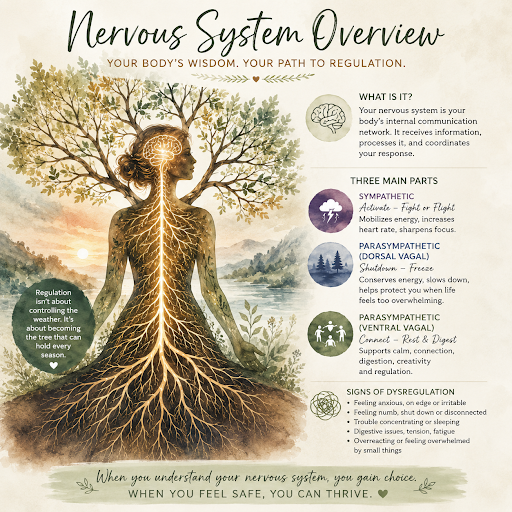
Your nervous system is your body’s communication network. It is constantly gathering information from both your outer world and your inner world, interpreting whether you are safe or threatened, and organizing responses accordingly.
Long before the thinking mind catches up, your nervous system has already begun making thousands of tiny adjustments: changing your heart rate, influencing digestion, shaping muscle tension, shifting attention, affecting emotion, and determining whether you move toward connection, protection, action, rest, or withdrawal.
Its primary job is not happiness. Its primary job is survival.
And yet, when functioning well, it gives us access to something much richer than survival alone: presence, flexibility, vitality, connection, and the ability to meet life with greater resilience.
A Bird’s-Eye View: Meet Your Nervous System
At the broadest level, the nervous system can be thought of as having two major parts..
1. The Central Nervous System (CNS)
This is made up of the brain and spinal cord.
Think of it as the body’s central processing center. The CNS receives information, interprets it, stores experiences, creates meaning, and helps coordinate responses.
It allows us to think, remember, imagine, make decisions, and initiate movement.
But interestingly, the brain is not operating alone. It is in constant conversation with the rest of the body.
Which brings us to the second major division…
2. The Peripheral Nervous System (PNS)
This includes the vast network of nerves extending throughout the body.
If the CNS is headquarters, the PNS is the communication highway.
Its job is to carry information back and forth between the brain, spinal cord, organs, muscles, and tissues.
One branch of the peripheral nervous system helps us move voluntarily, like lifting an arm or taking a walk.
Another branch operates largely outside conscious awareness.
This is called the autonomic nervous system, and this is where much of our future conversation will live.
The autonomic nervous system helps regulate functions like:
• Heart rate
• Breathing
• Digestion
• Blood pressure
• Energy use
• Stress responses
• Rest and recovery
Within the autonomic nervous system are different pathways that help us respond to life.
You may already be familiar with terms like sympathetic (often associated with mobilization, action, and protection) and parasympathetic (associated with restoration, connection, and conservation of energy).
These systems are not enemies competing against one another.
They are designed to work together in an ongoing dance of adaptation.
A healthy nervous system is not one that remains calm all the time.
It is one that can respond appropriately, recover, and return to balance.
As we move through this series, we’ll explore each branch in more depth and talk about how stress, trauma, relationships, lifestyle, and everyday experiences shape our nervous system over time.
For now, I’ll leave you with a question:
What signals is your nervous system receiving most often these days… urgency, pressure, and protection… or safety, connection, and enoughness?
Your body may already know the answer.

