
The Vagus Nerve and Your Nervous System: Learning to Listen to the Body
Continuing with my exploration of the nervous system, this month we’re going to take a closer look at the connection between the vagus nerve and the nervous system. If you’re new here, I invite you to explore my previous blogs on nervous system healing.
As I continue my own reading, research and learning, I find myself fascinated by the intricate ways our bodies are connected. The more I learn, the more I realize how much there is still to discover!
My interest in the vagus nerve is also deeply personal.
When the Body Speaks
I began experiencing fainting spells in early adolescence. My mother was understandably frightened and worried that I might have epilepsy. After numerous medical appointments and tests, we were relieved that nothing medically concerning had been identified. But we still had no explanation for why I was passing out.
Almost twenty-five years later, while deeply immersed in my own body-centered healing process, the fainting returned.
During that time, I began learning about the autonomic nervous system and the vagus nerve. I learned about vasovagal responses, in which changes in heart rate and blood pressure can cause someone to faint.
But for me, there was a much larger story.
Through my own healing work, I came to understand my fainting as a trauma response. My nervous system had known overwhelm from a very young, preverbal age. Long before I had the words or awareness to understand what I was experiencing, my body had developed ways of responding when things became too much.
For me, fainting felt like the ultimate form of dissociation, a complete disconnection from an experience that had become overwhelming.
Of course, I’m not suggesting that every fainting episode is related to trauma. Fainting can have many medical causes. I’m sharing how I came to understand my own experience.
What fascinated me was realizing that my body had been responding to experiences I hadn’t yet learned how to understand or process.
In many ways, my body had been communicating with me long before I understood its language.
And I suppose I’ve been learning that language ever since.
Let’s Start With the Nervous System
The nervous system is incredibly complex. The more I learn about it, the more I realize how much there is still to learn. I try to approach this subject with what I like to call beginner’s mind, bringing curiosity, openness and a willingness not to have all the answers.
At its most basic, our nervous system is a vast communication network. The brain and body are in conversation all day, every day, helping us respond to what’s happening around us and within us.
One part of that larger system is the autonomic nervous system, which helps regulate many of the things our bodies do without our consciously thinking about them, including heart rate, blood pressure and digestion.
You may remember from my previous blogs that two important branches of the autonomic nervous system are the sympathetic nervous system and the parasympathetic nervous system. If you’d like to explore either of these more deeply, I invite you to revisit those articles.
We often hear the sympathetic nervous system described as “fight or flight” and the parasympathetic as “rest and digest.” Those descriptions are helpful, but they’re only a starting point.
We need both.
We need the energy to move, respond, take action and protect ourselves when necessary. And we need the ability to slow down, digest, rest and restore.
Our nervous system is continually adjusting to what’s happening within us and around us. That’s what it’s designed to do.
So Where Does the Vagus Nerve Fit In?
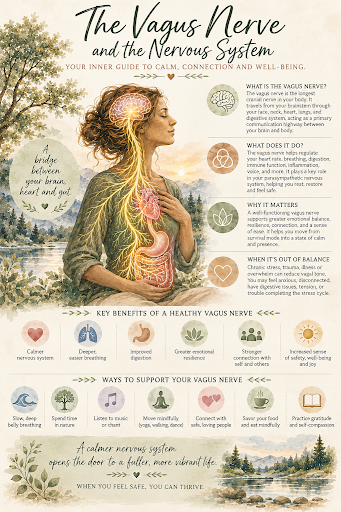
The vagus nerve is the tenth cranial nerve, also known as cranial nerve X. The word vagus comes from the Latin word for “wandering,” which is fitting when you consider how far it travels.
Beginning in the brainstem, the vagus nerve travels through the neck and into the chest and abdomen, communicating with many of our internal organs, including the heart, lungs and digestive tract.
It’s a major part of the parasympathetic nervous system.
But here’s what I find particularly fascinating.
We tend to think of the brain as the command center, sending instructions to the body.
Yet that’s only half the conversation.
Most of the fibers within the vagus nerve are afferent, meaning they carry sensory information from the body toward the brain.
In other words, our bodies are continually reporting back.
Our heart, lungs, digestive system and other internal organs are sending information that becomes part of the larger picture our nervous system is constantly interpreting and responding to.
Rather than thinking of communication as simply Brain to Body, we can begin to understand it’s a two way highway – communication is happening in both directions.
There’s an ongoing conversation happening within us all the time, and the vagus nerve is one important pathway in that communication.
It’s also worth remembering that, despite all the attention it receives these days, the vagus nerve is not the entire nervous system. It’s one part of a remarkably complex network.
Why Does This Matter?
Because we experience life through a body.
Think about some of the expressions we use every day:
I had a gut feeling.
My heart was pounding.
My stomach was in knots.
I couldn’t catch my breath.
We already have an intuitive understanding that what we’re experiencing emotionally and what’s happening physically are connected.
There’s actually a word for our ability to sense what’s happening inside our bodies: interoception.
Interoception includes our awareness of internal sensations such as our heartbeat, breathing, hunger, fullness, temperature and tension.
And this is where body-centered work becomes so meaningful to me.
We begin bringing awareness and curiosity to what we’re experiencing.
Instead of immediately trying to change a sensation, what happens if we pause long enough to notice it?
What am I feeling right now?
Where do I feel it in my body?
What happens when I give it a little space?
And perhaps most importantly:
What might my body be trying to communicate?
We don’t need to know the answer right away. In fact, curiosity is quite different from trying to figure ourselves out.
Maybe the tightness in my chest is telling me I need to slow down. Maybe the energy moving through my arms is anger that needs acknowledgment. Maybe the heaviness I’m feeling is grief. Or perhaps my body needs movement, rest, connection or a boundary.
And sometimes a sensation is simply a sensation.
The invitation isn’t to assign meaning to everything we feel. It’s to become more curious about our experiences and more available to ourselves.
One of the simplest principles I use in my work is:
Notice, not fix.
For me, that means learning how to be with ourselves and our sensations, rather than immediately needing them to be different.
What About “Toning” the Vagus Nerve?
There’s a tremendous amount of information circulating about vagal tone, stimulating the vagus nerve and “resetting” the nervous system.
Some of it is helpful. Some of it, in my opinion, makes a very complex system sound a little too simple.
Slow breathing, for example, has been studied in relation to autonomic regulation and heart-rate variability, or HRV. HRV is one measure researchers use when studying autonomic function, but it isn’t a simple report card for the health of your vagus nerve.
Practices such as breathing, humming, singing, gentle movement, yoga, meditation, grounding and supportive connection may influence our physiology and help us become more aware of what’s happening within us.
I use many of these practices myself and in my work.
I think of them as resources for the nervous system; not magic.
When we change our breathing, move our bodies, use our voices, connect with another person or bring attention to our sensations, we’re offering different information to a nervous system that’s continually listening and responding.
Sometimes those practices help create just a little more room to be with ourselves and whatever we’re experiencing.
For me, that’s far more interesting than the promise of a quick “reset.”
Learning to Listen
When I think back to that young girl who was fainting, I realize how much my relationship with my body has changed.
Back then, the question was understandably, “What is wrong?”
Years later, through body-centered work, I began asking something different.
“What is happening?”
And eventually, “What is my body communicating?”
That shift has influenced so much of the work I’ve done ever since.
Our bodies are communicating with us all the time. Sometimes the signals are subtle. Sometimes, as they were for me, they’re very loud and obvious!.
Understanding the vagus nerve offers another fascinating window into the ongoing conversation between brain and body.
It isn’t the whole nervous system, and it certainly isn’t a magic switch. Nor do I believe the goal is to control every response our bodies have.
Perhaps the invitation is simply to become more aware, more curious and more willing to listen.
To learn how to be with ourselves and our sensations, with a little more compassion and a little less urgency to change them.
And to occasionally ask:
What might my body be trying to communicate?
We don’t always need an answer.
Sometimes the beginning is simply learning how to listen and become curious.
Notice, not fix.
